


BOOK EXCERPT: Martina Clark was the first person openly living with HIV to work for UNAIDS. A look back at her legacy and to the future legacy of Trump’s policies
Editor’s note: In UNSTOPPABLE: Straight Women on the AIDS Frontlines, Victoria Noe returns to the subject of her award-winning 2019 book, F*g Hags, Divas and Moms: The Legacy of Straight Women in the AIDS Community. But this time, the author focuses on the shifting public health environment of today. With the decimation of U.S. aid in the global fight against HIV, it only seemed timely to feature an excerpt from Noe’s book, a chapter on Martina Clark, the first person openly living with HIV to work at UNAIDS.
Introduction
I happened to be in New York City in the fall of 2021 when Martina Clark held her book launch at Housing Works Cafe and Bookstore. We’d never met, though we had many mutual friends. I dug into My Unexpected Life: An International Memoir of Two Pandemics, HIV and COVID-19 not knowing what to expect.
The HIV community is full of stories. I’ve devoted most of the past ten years to sharing the ones about straight women. Every story, like every person, is unique and powerful. But Martina’s stands apart, recounting a story that is both international and very local. That’s why I made her story its own chapter in Unstoppable: Straight Women on the AIDS Frontlines. We have a lot to learn from Martina—about vulnerability, about determination, and about channeling the rage that we all feel right now.
Chapter 2 - Around the World and at Home
“I worry about people that aren’t that angry.” —Martina Clark
The first few months of 2025 have seen the dismantling of much of the progress in the HIV/AIDS community over the past 40+ years. Clinical trials, research, education, support services, and medical treatments were shut down with little notice, and little hope of revival. Jobs have been lost, accomplishments erased. The stated purpose of eliminating government waste and fraud has served only to hurt the most vulnerable people in our society, in the US and abroad. Because so many in this community fit into the definition of DEI—diversity, equity and inclusion—by virtue of being women, LGBTQ, or people of color, these draconian cuts have already proven to be life-threatening.
USAID [the U.S. Agency for International Development] was established by President John F. Kennedy to bring several foreign aid agencies under one umbrella. The singular accomplishment of George W. Bush’s controversial administration is a program that falls under USAID: the 2003 executive order creating PEPFAR, the President’s Emergency Plan for AIDS Relief. An example of what Bush termed ‘compassionate conservatism’ to combat AIDS in Africa, the idea was originally proposed by Dr. Anthony Fauci from the National Institutes of Health. Its effectiveness is not a debatable point. Between its inception and January 2025, PEPFAR has saved over 25 million lives, supported antiretroviral treatment for nearly 20.5 million people, and provided HIV-free outcomes for 5.5 million babies born to mothers living with HIV.
It’s one of the most successful global health initiatives in history. At least it was until January 2025, when its funding was cut off by the second Trump administration.
After the inauguration, I went back to several of the women in this book to re-interview them. When I talked to them after the election, they were worried and a little scared, not sure what a Trump re-election would mean for them. After January 20, they knew what it meant: life or death. Their anger did not surprise me, but the intensity of the rage was not like anything I’d seen before.
They watched their life’s work—whether a few years or decades—destroyed in a matter of weeks. And for those who live with HIV, the consequences were much more severe. No one epitomizes this situation more than Martina Clark.
Clark’s story begins in 1992, when she was diagnosed with HIV. Although living in San Francisco at the time, where AIDS was decimating the LGBT community, she believed that this illness was something that only affected the people around her. The doctor who delivered her diagnosis could give little information because she was the first HIV-positive woman he’d ever treated.
Like other HIV-positive straight women in this book, Clark had to find her own community. By necessity and by choice, she became an advocate “to stay one step ahead,” she told me. Clark wanted to find meaning in her diagnosis. In some ways, she had an advantage because being an HIV-positive woman, she was not impacted by homophobia.
“It was easier as a straight woman to tell my story then. There was no stigma about me as a person.”
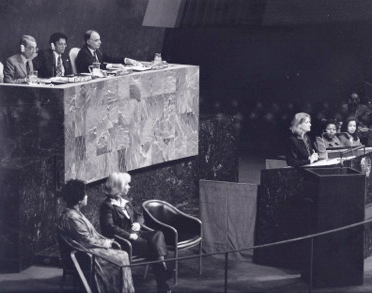
Martina Clark addressing UN General Assembly, 1996 (photo courtesy of Martina Clark)
Her advocacy in San Francisco led to an opportunity to fulfill a long-time interest that was the focus of her college degree: international work. Clark became the first openly HIV-positive person to work for UNAIDS, the United Nations Programme on HIV/AIDS. Created by UN resolution in 1994, it began operations in 1996. Clark began working for them that year, as their original liaison officer. She also served as HIV in the Workplace Program Manager for UNICEF (globally) and UN Cares Regional Coordinator (Middle East and North Africa).
When I spoke to her in March 2025 about her work for UNAIDS, the anger was palpable.
“People are dying already. Already new infections. How many babies will get HIV because they don’t have the $3 for treatment? Evil is the only way I can think of it. I’m certain things could be restructured for efficiencies, [but this is] callous and cruel. The damage is done and [we] will have to start over again…the way they’re doing it is evil.”
Because of Clark’s workplace vantage point, she sees the ripple effect of shutting down USAID in general and PEPFAR in particular.
“UNAIDS work is impacted by the US pulling out of WHO (World Health organization), etc. They’re losing their funding, too…Other development agencies—UK, French, German, Swedish — might be able to step in. They might have people in place, but their specialties [which are different for every agency] might not be helpful.
“Poor countries don’t have a lot of options. We pulled the rug out.”
“Pulled the rug out” is a charitable way of describing the effects of cutting off funding for HIV prevention and treatment. UNAIDS has warned that discontinuation of funding will result in an additional 4.2 million AIDS-related deaths between 2025 and 2029. Even with the $400 million in PEPFAR funding restored in July 2025, those funds must be spent before the end of the fiscal year in October. It will be a scramble to call back staff as well as order and distribute medications and testing kits. That reprieve will likely be temporary, as the U.S. State Department is developing plans to transform PEPFAR over the next few years into a platform for rapid detection and outbreak response to protect Americans from disease threats like Ebola, not HIV.
When we spoke that day, Clark still believed her work was valuable.
“We fought this battle forty years ago. I know my work made a difference; it’s already been validated. I know it mattered. No regrets. Is that work now completely undone? Probably, some of it.’
Most of her work was conducted thousands of miles away from where she now lives in Brooklyn. Clark understands that talking about HIV and AIDS in other countries may not register with people who still think of HIV as a gay issue.
“I worry about the people who aren’t that angry. I’m so lucky because I have the privilege of being a white woman with a backup. I worry about people who are angry with no options.”
The general perception is that people become very sick very quickly after they become HIV-positive. That’s certainly the norm. Clark, however, is one of those people who did not get sick early on. She did not get sick until 2007; other than stigma, HIV didn’t really affect her life.
“Treatment was not medically indicated, so you assume you don’t need it. Then everything changed. It felt like grieving not having to take meds for 16 years. I grieved needing to use condoms for HIV, not pregnancy.”
When we spoke at her apartment in Brooklyn, Clark and I discussed how COVID triggered long-term survivors.
“My mind kept going back and forth between San Francisco in the ’80s and New York City in 2020. Again living in a war zone with joyful people, [but] better prepared to deal with it. What happened was familiar in a way.”
But early in 2020, Clark contracted COVID and experienced a severe response to the virus, leaving her with a constant headache since May 2020, and limited vision in her left eye. She can no longer use a computer comfortably and had to quit her teaching job.
In 2023, she began the process to apply for Social Security disability benefits. Clark told me that what should have been an easy decision on their part has been fraught with delays, including appeals.
“Social Security has acknowledged that I am, indeed, disabled, but maybe just not quite enough to access the money I’ve been paying into [the system] for the past 46 years since I had my first job at 14. Forty-six years of jobs as a civil servant, educator, and in service to my community.”
Like other long-term survivors, Clark’s current concern is the ability to afford her life-saving medications, which run about $4,700/month without insurance. The stress of being in limbo about her disability status takes an understandable and unnecessary toll on her health.
Because of the power of Clark’s story, and the chaos inflicted on her both personally and professionally, I asked two questions she probably thought were crazy: What brings you joy? What brings you hope? It turns out, she had just been asked to submit an essay about hope for an anthology. Her answer has actually guided me as I continued to work on this book.
“Joy is of the moment. Hope is about the future. Only by seeking joy every day can we begin to develop hope moving forward.”
UNSTOPPABLE: Straight Women on the AIDS Frontlines is available at victorianoe.com/product/unstoppable.